

Radio Tavana
Designing an Internal Podcast Platform for Knowledge Sharing
An enterprise podcast experience for employees to exchange professional knowledge, share workplace experiences, and discover relevant audio content.
- Role
- Sole Product Designer — UX & UI
- Duration
- 2 weeks
- Collaboration
- Frontend developer, backend developer, product manager
- Outcome
- Core UX & UI design completed; development in progress, with Listener Club design ongoing
Project Overview
Turning Workplace Experience into Shared Knowledge
Radio Tavana is an internal podcast platform designed for employees of an electricity distribution organization.
The idea emerged from a simple organizational need: enabling employees to share their professional experiences, practical knowledge, and workplace insights with their colleagues.
Rather than relying solely on conventional knowledge-sharing formats, the platform introduces audio as an accessible way for employees to learn from one another.
Unlike public podcast services, Radio Tavana operates within a closed organizational environment. Employee identities are already established, publishing permissions are controlled, and content must follow an administrative approval process.
The Design Challenge
How might we create a familiar and engaging podcast experience for employees with varying levels of digital experience, while supporting the access controls, content structure, and publishing requirements of an enterprise environment?
Research & Design Approach
Understanding the Audience Before Designing the Experience
As the Product Designer responsible for both UX and UI, I approached Radio Tavana by exploring the needs of its organizational audience and the constraints of an internal publishing platform.
The research process combined employee interviews, stakeholder discussions, and competitive analysis of existing podcast experiences.
These activities informed the platform's information architecture, navigation, listening interactions, and content creation workflows.
A central consideration was usability for employees with different levels of familiarity with digital products.
Instead of reproducing the full complexity of consumer podcast platforms, I focused on identifying familiar interaction patterns that could be adapted to an internal organizational context.
Design Priorities
- Make content discovery and playback easy to understand.
- Reduce unnecessary steps in common user journeys.
- Organize podcast content through a clear hierarchy.
- Support employee contributions without introducing an open publishing system.
- Maintain consistency across listening, browsing, and content management experiences.
Designing for an Internal Audience
Simplifying Authentication and Navigation
Because Radio Tavana serves a predefined group of employees, traditional public registration was unnecessary.
Employee accounts are managed through existing organizational records, allowing the experience to focus on login rather than sign-up.
This decision removes an additional onboarding step and keeps user access aligned with the organization's internal systems.
A Familiar Navigation Experience
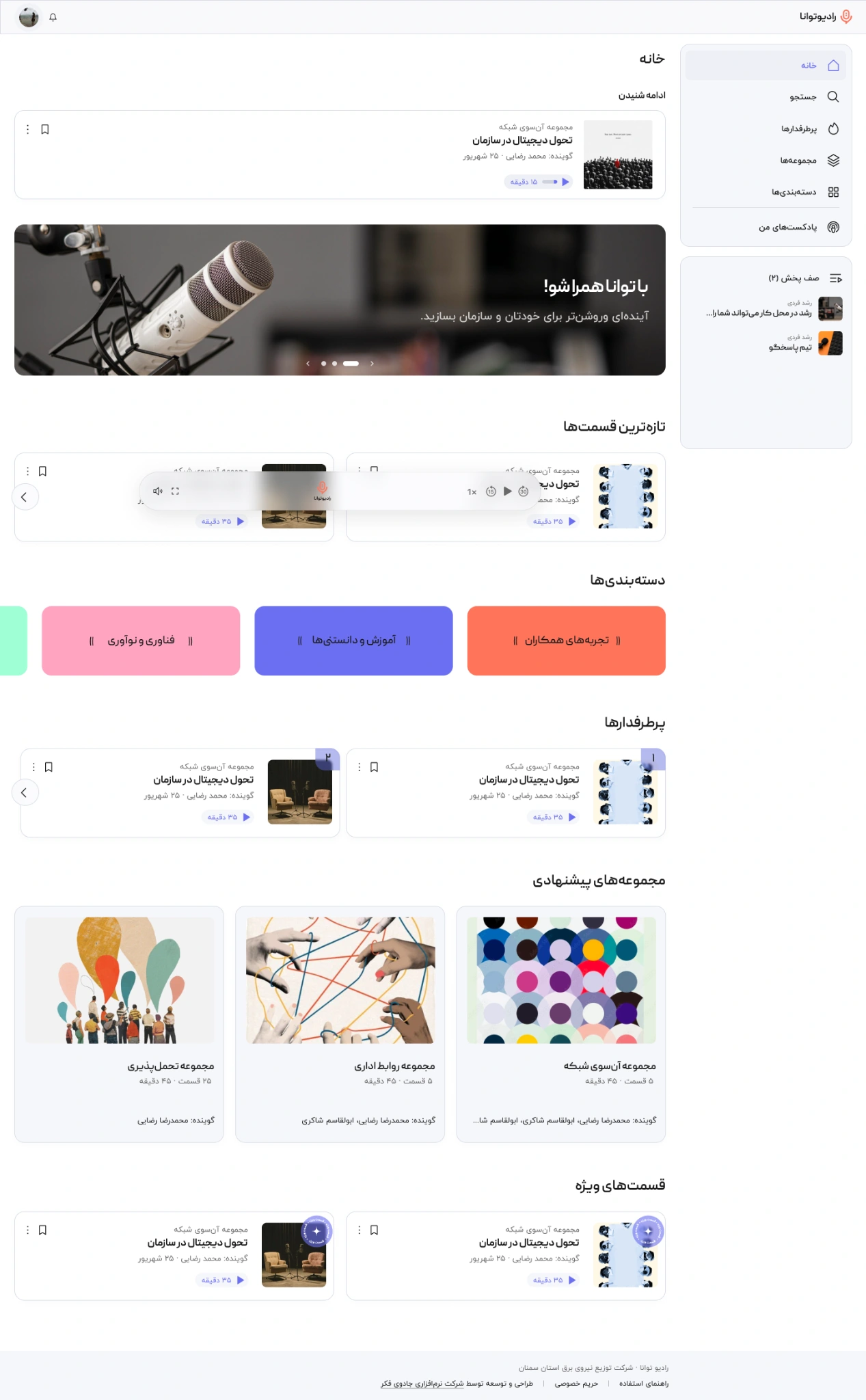
The main navigation was organized around a limited number of recognizable destinations: Home, Search, Popular Episodes, Series, and Categories.
The Home page combines content discovery with listening continuity through sections such as Continue Listening, Latest Episodes, Recommended Series, Popular Episodes, and Special Episodes.
This structure helps returning listeners resume their previous activity while giving other employees clear ways to explore available content.
The interface also provides a dedicated area for authorized employees to manage their own podcast submissions.
Key Design Decisions
- Removed public registration.
- Designed access around existing employee records.
- Used clear, familiar navigation labels.
- Prioritized frequently used listening and discovery actions.
- Separated general content browsing from creator-specific workflows.
Structuring Podcast Content
Defining the Relationship Between Series, Seasons, and Episodes
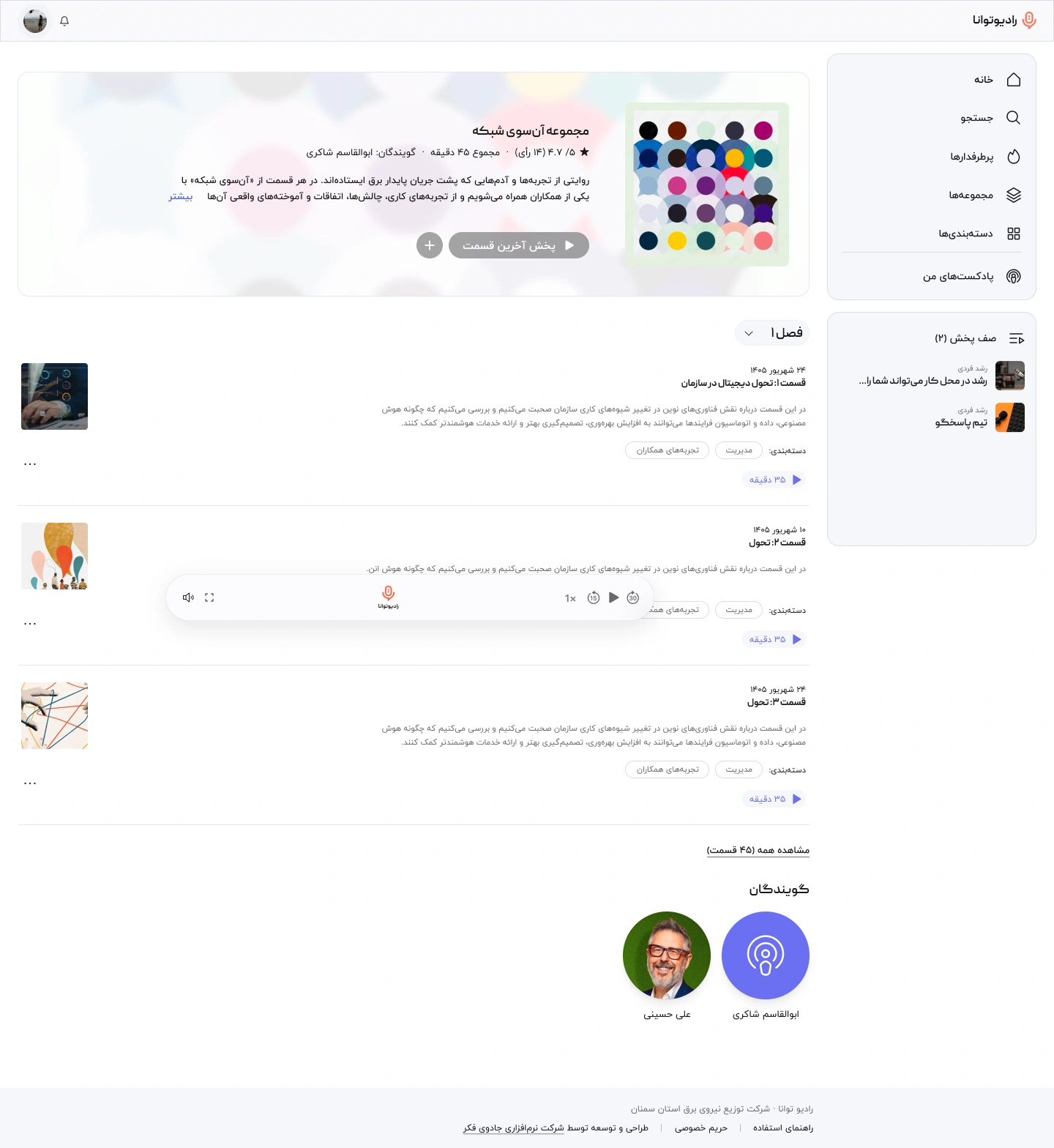
One of the important design decisions was establishing a clear content hierarchy.
Series Season Episode
A series contains seasons, and each season contains individual episodes.
This structure allows related recordings to remain organized while supporting direct access to individual content.
Different Content Types, Different Card Behaviors
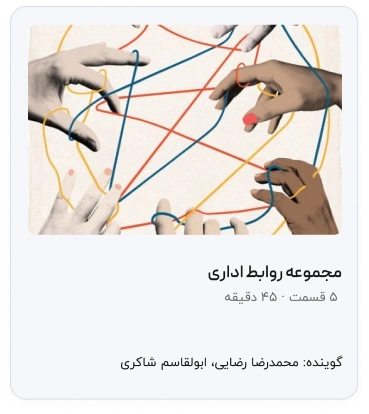
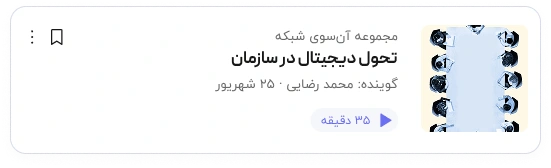
Rather than using identical components for every content type, I designed separate card patterns based on their purpose.
Series Cards focus on discovery and collection-level information. They display the series cover, title, episode count, total listening duration, and associated speakers.
Episode Cards prioritize immediate playback. Each card includes the episode cover, title, parent series, speaker, publication date, duration, and a direct play action.
Secondary interactions, such as saving an episode or opening additional options, remain accessible without competing with playback.
Categorizing Episodes Instead of Series
Another important decision was applying categories at the episode level rather than to entire series.
A single series may explore several subjects, making a series-level category too broad to accurately describe all its content.
Episode-level categorization allows users to discover recordings based on their specific topics, regardless of which collection they belong to.
This keeps the information architecture flexible without adding unnecessary layers of classification.
A Continuous Listening Experience
Keeping Playback Accessible Across the Platform
Listening is the core activity of Radio Tavana, so users should be able to move between pages without losing access to playback controls.
I designed a persistent mini-player that remains accessible throughout the browsing experience.
An expanded player provides a more focused listening interface, including playback progress, seeking, playback speed, and volume controls.
The Continue Listening section helps users return to unfinished episodes without manually locating their previous listening position.
A Personal, Persistent Playback Queue
Each employee has an individual playback queue that is saved to their account and remains available when they return to the platform.
Rather than hiding upcoming episodes inside a secondary menu, I placed the queue in the sidebar.
This gives users a clear view of their current listening context and upcoming content while allowing them to continue exploring the platform.
The decision was particularly relevant for an audience that benefits from visible, predictable interactions.
Key Design Decisions
- Persistent mini-player across the application.
- Expanded player for focused listening.
- Individual playback queues saved per user.
- Visible queue within the sidebar.
- Continue Listening for unfinished episodes.
- Familiar playback controls and clear interaction states.
Employee-Generated Content
Enabling Contributions Through Role-Based Access
Radio Tavana goes beyond passive listening by enabling designated employees to contribute professional experiences and knowledge through audio content.
However, content creation is not available to every employee.
Creator permissions are assigned directly by administrators, and the platform does not introduce a separate access-request process.
This keeps publishing responsibilities clearly defined within the organization.
Simplifying the Creation Workflow
To make content creation approachable, I separated series creation from episode submission.
Creators first establish a series, then add episodes within its seasons.
For the initial creation experience, the first season is handled automatically, reducing unnecessary decisions before adding the first episode.
Live previews allow creators to see how their content will appear before submitting it, helping them identify mistakes and understand the result of their input.
Controlled Publishing and Approval
Creating a series or uploading an episode does not make it publicly available.
New content remains private until reviewed and approved by an administrator.
A series becomes visible to other employees only after the series itself and at least one of its episodes have been approved for publication.
Creators can track their submissions through clear statuses, including Draft, Pending Review, Needs Revision, Published, and Rejected.
Key Design Decisions
- Administrator-assigned creator permissions.
- Separate series and episode creation flows.
- Automatic initial-season handling.
- Live previews before submission.
- Clear submission and approval statuses.
- Restricted public visibility until approval.
This approach supports employee participation while maintaining organizational oversight.
Meaningful Engagement
Connecting Feedback to Individual Episodes
Radio Tavana supports interaction through saved episodes, ratings, and comments.
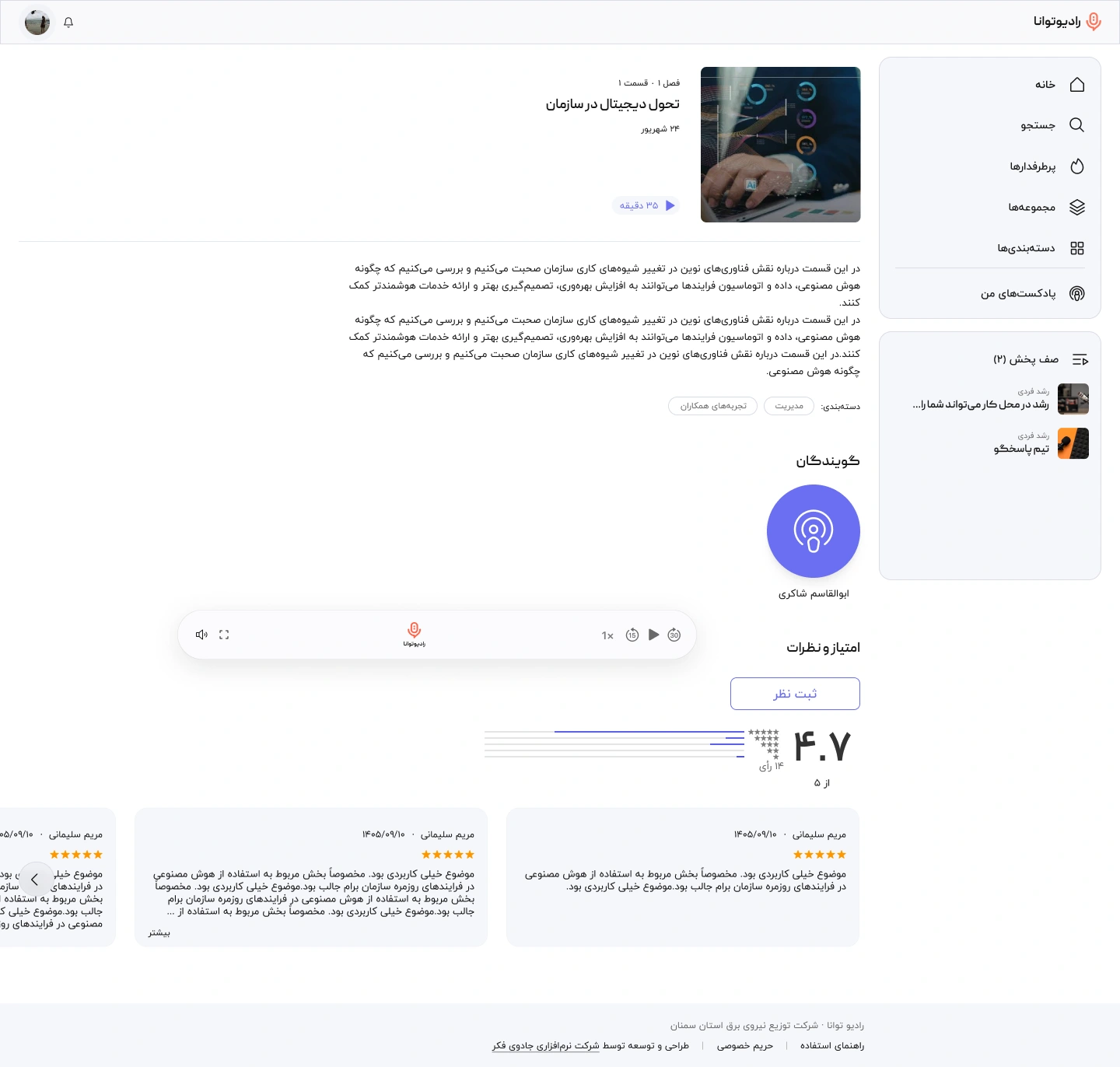
I designed ratings and reviews around individual episodes rather than entire series, allowing feedback to remain connected to the specific recording a user has listened to.
The episode detail page presents an overall rating, rating distribution, listener comments, and an action for submitting feedback.
For episodes without ratings, compact cards can omit rating information rather than displaying a misleading zero score.
Comments are subject to administrative review before becoming publicly visible.
Encouraging Participation Beyond Listening
The product also includes a Listener Club concept based on participation points, levels, badges, rankings, and campaigns.
This part of the experience is currently being designed.
Its purpose is to recognize employee participation and create additional opportunities for engagement without distracting from the platform's primary knowledge-sharing experience.
A Consistent Design Experience
Familiar Patterns, Less Cognitive Effort
Radio Tavana was designed around clarity, consistency, and predictable interactions.
Reusable components support episode cards, series cards, playback controls, navigation, and content management states.
Each content type has a distinct visual treatment, while shared interactions remain consistent across the platform.
The interface uses clear typography, recognizable icons, restrained colors, and consistent spacing to make the experience approachable for employees with different levels of digital familiarity.
Responsive layouts were also considered to maintain access to essential listening and navigation functions across devices.
The goal was not to introduce more features into the interface, but to make the essential interactions easier to understand and use.
Design Outcome & Reflection
Establishing a Foundation for Organizational Knowledge Sharing
With the core product design completed and development currently in progress, Radio Tavana has a defined UX architecture for content discovery, audio listening, employee contributions, and controlled publishing.
The design establishes a consistent experience tailored to the needs of an internal organizational audience.
Key Design Deliverables
- Login-focused authentication without public registration.
- A clear Series Season Episode content hierarchy.
- Distinct, reusable series and episode card components.
- Episode-level categorization and feedback.
- Persistent playback controls and saved personal listening queues.
- Guided content creation for authorized employees.
- Administrator-controlled publishing and approval workflows.
- A responsive interface designed for employees with varying levels of digital experience.
The Listener Club remains an ongoing design workstream.
As the product is still in development, user adoption, engagement, and other post-launch performance outcomes have not yet been measured.
Reflection
Designing Radio Tavana reinforced the importance of adapting familiar consumer-product experiences to the realities of enterprise environments.
The challenge was not simply to introduce podcast functionality, but to determine which interactions should remain familiar, which workflows needed simplification, and where organizational requirements demanded additional control.
The project reflects my approach to product design: balancing user needs, technical constraints, and organizational goals to create experiences that are both approachable and structurally sound.